As defense and aerospace platforms continue to evolve toward data-centric operations, Ethernet has become the backbone of embedded communications. Today's mission systems must move significantly more data between sensors, processors, storage, and communications equipment, while maintaining reliability in the harshest operating environments. Engineers need to not only think about how Ethernet is incorporated into a rugged embedded system, but also how those high-speed connections extend beyond the chassis.
A recent webinar co-hosted with our partner, Interface Concept, explores the challenges and practical solutions for implementing rugged Ethernet connectivity and highlights that successful networking isn't simply about adding faster interfaces. It’s imperative to design an integrated architecture that maintains signal integrity, interoperability, and rugged reliability from the backplane to the platform edge.
Ethernet Within the Modern System
Today’s C5ISR, electronic warfare(EW), radar, and sensor fusion applications demand higher bandwidths to support increasingly sophisticated processing and real-time decision making. Ethernet has been steadily replacing legacy technologies, including sFPDP, Serial RapidIO, and AFDX, across military platforms. In fact, it now serves as the primary internal fabric connecting processors, storage, radios, and sensors throughout rugged VPX systems. (Figure 1)

A combination of 1GbE, 10GbE,25GbE, 40GbE, and even 100GbE links are commonly found in these modern systems.The need to transition from the internal sub-system to external interfaces canpresent challenges, due to some inherent technical complexities.
The Role of Ethernet Switching
Extending Ethernet connectivitybeyond a rugged embedded system requires more than routing VPX backplanesignals to an external connector. While the backplane provides high-speedcommunication within the chassis, Ethernet switches act as the transition pointbetween the internal network fabric and external devices. This enables a systemto aggregate traffic from multiple processing and I/O modules, withstandards-based Ethernet interfaces implemented at the chassis edge.
Rather than relying on point-to-point connections, a switch-based architecture allows multiple chassis or remote subsystems to communicate over a managed Ethernet network. This improves bandwidth utilization, and simplifies expansion to support redundancy where mission-critical reliability is required. (Figure 2)
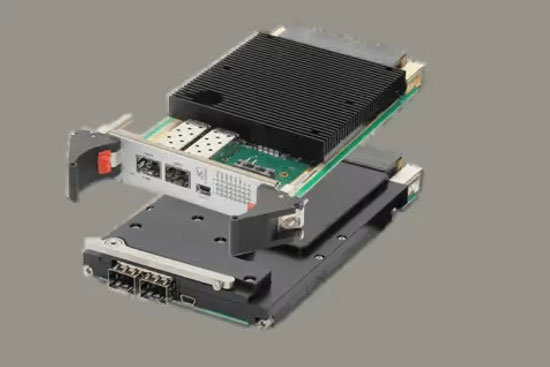
Moving Ethernet Beyond the Chassis
While Ethernet inside a VPX chassis is well understood, transitioning those signals outside the enclosure presents a different engineering complication.
Selecting the right approach depends on mission requirements, maintenance philosophy, and available system resources. To determine the best method, system architects should balance ruggedness, serviceability, bandwidth requirements, and available chassis space.
Analyze a number of important design elements, each of which affects system performance and reliability, to help determine the appropriate strategy. These can include:
- Copper or fiber media
- Media conversion technologies
- Connectors and cabling
- Rugged Ethernet switching
- Thermal management
- Signal conditioning
With media conversion, for example, the appropriate control interface must be provided from MAC to PHY, or auto-negotiation will not work. This includes provisions for static configuration of PHY and other end points.
"Bolt-on" solutions can impact thermal management, subsequently being overlooked when evaluating the entire thermal profile. The effect this can have on PHYs and Optical transceivers, in particular, is noteworthy.
Standards Reduce Complexity
One of the biggest challenges in rugged networking is interoperability.
The sheer number of Ethernet protocols, connector options, and implementation methods can complicate system integration, particularly when multiple vendors are involved. Standards such as SOSA® significantly reduce this complexity by defining preferred protocols, connector types, and electrical interfaces.
For example, the SOSA Technical Standard specifies rugged D38999 connector variants for both copper and fiber Ethernet implementations while also supporting high-density MT ferrule optical connections capable of carrying multiple 100GbE links. These standardized interfaces improve compatibility while reducing engineering risk during system integration. (Figure 3)

Cabling Considerations forHigh-speed Performance
The implementation of high-speed Ethernet cabling, both within a chassis and routed beyond, can significantly affect system performance, if certain physical characteristics are not considered.
Inside the chassis, engineers must carefully route copper and fiber cabling while respecting bend radius limitations and accounting for the backplane signal interfaces. Re-drivers may be required when signals travel across multiple connectors before reaching media conversion hardware.
Outside the enclosure, cable quality, EMI shielding, fiber protection, and connector cleanliness all become critical. Even seemingly minor infractions, like transmit/receive crossover errors, incorrect MT ferrule ordering, or a cable rated for the wrong signal speed, can significantly impact system performance and reliability.
Ethernet Advances in System Networking
Elma Electronic approach is to address Ethernet as a complete system rather than viewing networking as an isolated subsystem. System networking is part of a complete embedded computing environment that integrates thermal management, signal integrity, mechanical packaging, and standards compliance into a unified system.
As military platforms continue their transition toward distributed processing, artificial intelligence, sensor fusion, and multi-domain operations, Ethernet will remain the primary networking technology enabling these capabilities. Success will increasingly depend on architectures that deliver high bandwidth while maintaining interoperability, ruggedness, and long-term serviceability.
Looking for deeper insights? Watch our on-demand webinar “Ethernet Connectivity Between Rugged Embedded Systems”

