Mezzanine cards have long been used in embedded computing to enhance the performance of electronic devices to extend or change functionality, features or connectivity options within an existing system. For almost 20 years, XMC has served as the basis for many mezzanine card implementations.
VITA’s upcoming QMC (VITA 93) standard uses the same concepts as VITA 42, the pre-eminent XMC standard, to support high-speed, switched interconnect mezzanine cards, but it also provides enhanced performance in an exceptionally small form factor.
QMC is not only compact and able to handle high processing loads, but it also introduces a highly modular, flexible and scalable approach to I/O integration that enables users to mix and match I/O functions on a number of open standards platforms. Its broad applicability extends beyond aerospace and defense into several high-speed data environments found throughout the industrial, transportation, energy and manufacturing markets as well as in medical and scientific research.
So, we asked some of our QMC partners: How will QMC help system designers address today’s data processing requirements in rugged, deployed applications and why was it needed?
Contributor: Tim Tews, General Manager, TEWS Technologies GmbH
The new VITA 93 - QMC standard is an essential advancement for meeting today’s embedded system challenges, especially in rugged, deployed applications across the aerospace, defense, industrial, and transportation markets.
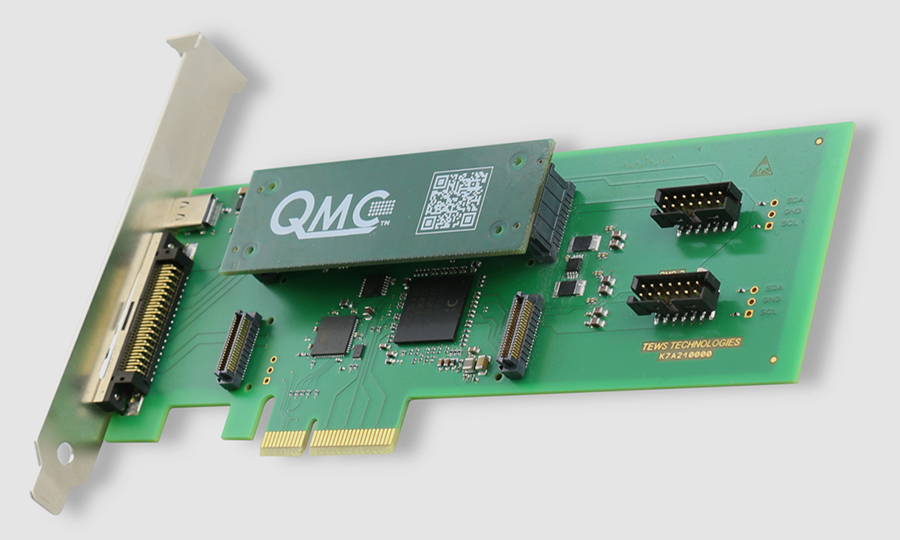
While traditional mezzanine standards, such as XMC, have served well, they struggle to meet modern requirements for scalability, thermal efficiency, and SWaP (size, weight, and power). QMC addresses these limitations with a highly modular, flexible, and scalable architecture. It enables system designers to mix and match single to quad modules – supporting up to x16 PCIe lanes and 160 I/Os – all within a much smaller footprint than legacy standards.
QMC was designed with versatility in mind. A single design supports both air- and conduction-cooled implementations, simplifying integration and reducing product variants. Variable stacking heights and a standardized mechanical interface mean designers can optimize layout, cooling, and carrier space usage without vendor lock-in. (Figure 1)
TEWS Technologies has played a key role in the development of the new VITA 93 – QMC standard, and we are investing heavily in QMC. Our portfolio includes QMC modules for serial I/O, reconfigurable FPGAs, Ethernet, CAN, analog and digital I/O, backed by robust driver support and a standard five-year warranty. More functionalities and carriers will become available soon, driven by customer request.
Contributor: Robert Greenfield, Business Development Manager, Acromag, Inc.
The rationale for the VITA 93 QMC mezzanine can be summarized in four words: smaller, faster, rugged, and standardized.
In defense and aerospace applications, the talk is often of requirements in terms of SWaP. The trend towards unmanned vehicles (airborne, marine, and ground-based) has accelerated the need for smaller systems. Many of the I/O functions implemented on a PMC or XMC board can now fit on a single or double-size QMC module, with less than a quarter or half the footprint, and much lighter. (Figure 2)
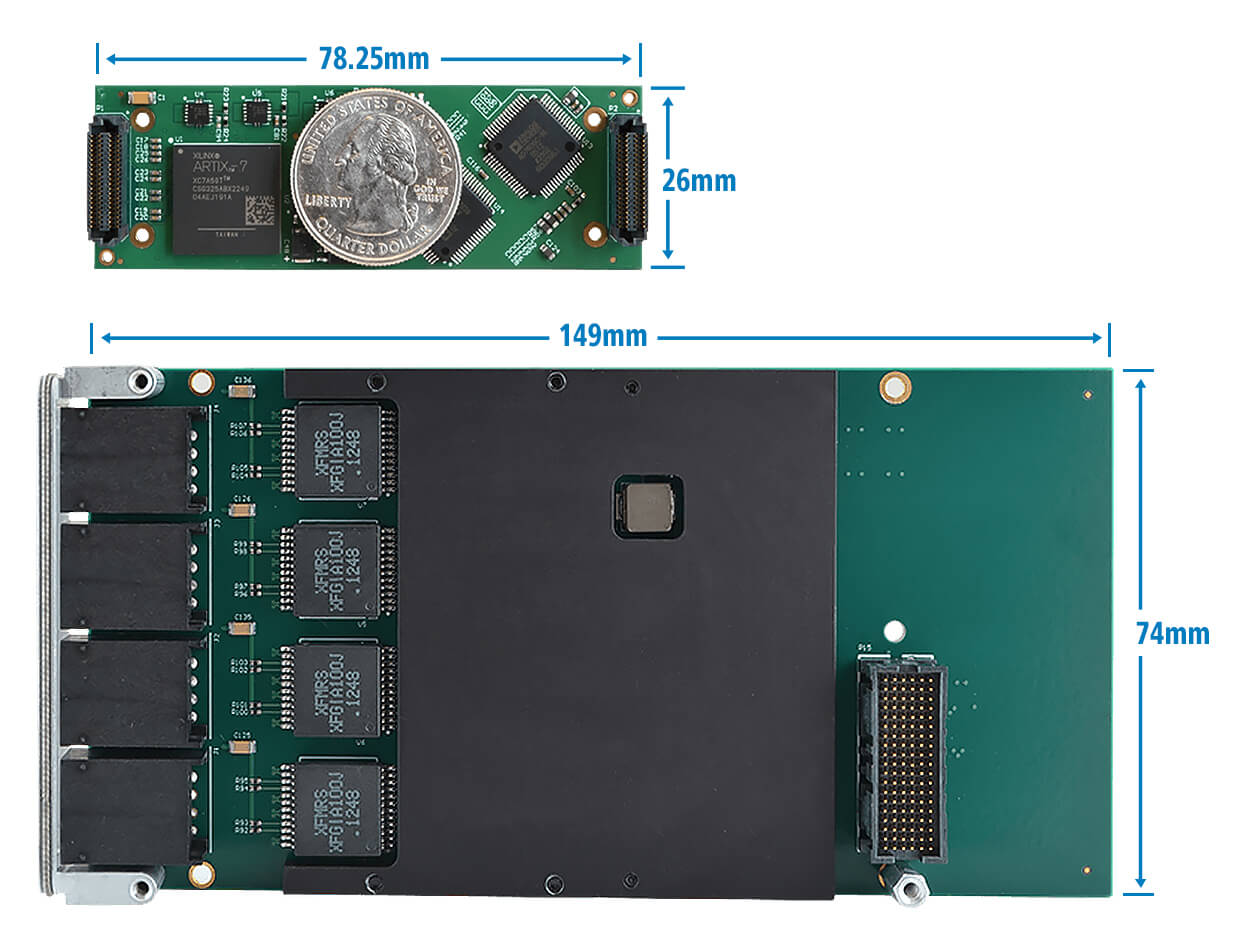
While PCIe mini cards and M.2 modules are similar in size to a QMC, they cannot match the performance of QMC. The PCIe mini card is limited to a PCIe Gen 2 one-lane interface, which is too slow for many modern computing applications, like high-speed serial communication, image/video processing, and AI. M.2 can support faster PCIe with up to four lanes, but the QMC can scale to double, triple, and quad-wide modules providing x8, x12, and x16 lane capabilities.
The QMC module was intentionally designed for systems deployed in harsh environments. The board-to-board connectors for both I/O and host interfaces provide durable mating with shock and vibration resistance. No loose internal wiring is needed to bridge the I/O signals to external cable connectors. And to support use in fanless computing systems, QMC modules offer a skyline heatsink to facilitate conduction cooling.
These aforementioned performance factors are critical, but perhaps even more important are the steps taken to standardize the I/O connections for faster system integration and interoperability with all carrier cards. Unlike mini PCIe and M.2, the QMC I/O connector is tightly defined for predictable pin routing to a standard field cable connector, without custom adapters for each module. Similarly, the standard heatsink design ensures every QMC module will mate perfectly to the conduction-cooling metalwork on the carrier card for optimal heat transfer.
By providing a modular solution with all four critical aspects of being fast, small, rugged, and standardized, the QMC mezzanine is well-suited for use in a broad range of applications. With the flexibility to perform many signal processing functions on a variety of computing system platforms, QMCs are ready for deployment in defense, transportation, manufacturing, and beyond.
Contributor: Mark Littlefield, Director, Systems Products, Elma Electronic
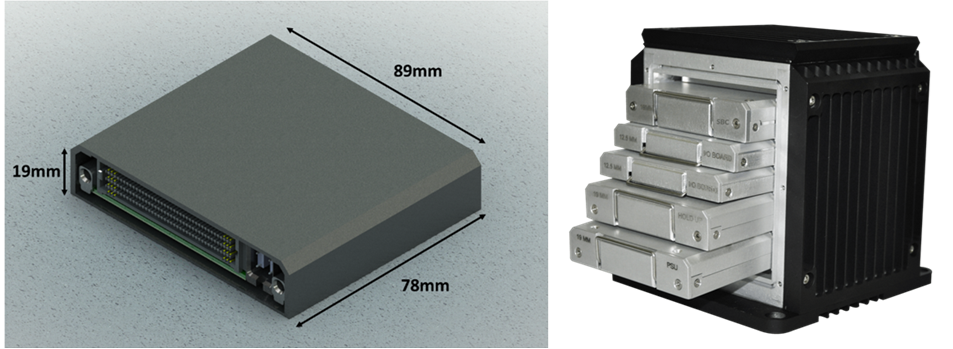
For Elma, the primary driver for developing the QMC standard was to give VNX+ (VITA 90) a mezzanine I/O expansion capability comparable to what XMC gives OpenVPX. VNX+’s small size (about 30% the size of OpenVPX per slot - see Figure 3) was simply too small for XMC, so an alternative was needed, and QMC was born.
QMC provides the critical features of XMC, including a high-performance host-side connector paired with a similar I/O side connector (comparable to XMC’s P15 and P16 connectors, but supporting higher speed protocols) in a package sized to permit two modules to be installed in a basic 19mm VNX+ module (or one double-sized module, if you like).
Unlike XMC, QMC was designed with cooling in mind, giving designers the means to easily provide air- or conduction-cooling structures on both the carrier and QMC side. All this provides an “any QMC on any carrier” capability, which is not only critical to ensure compatibility between COTS products across different vendors, but is especially useful in lab and prototype environments, where one might marry, say, an air-cooled carrier with a production-grade conduction-cooled QMC (or vice-versa) for testing.
QMC’s utility reaches well beyond VNX+, however. Care was taken so that QMC was compatible with a wide range of form factors, including OpenVPX (3U and 6U, down to 0.8” pitch), CompactPCI and CompactPCI Serial, traditional PCI Express edge-connector cards, and even VME. Even VITA 100, VITA's next-generation high-performance form factor, will support QMC from its start, and it is expected that QMC sites will eventually appear on other unexpected form factors and applications as the market grows and evolves – especially where compact size and standardized I/O are critical attributes.
What is QMC (VITA 93) and why is it important?
QMC (VITA 93) is a small-form-factor mezzanine module standard that enables high-speed I/O expansion in modular embedded systems. In Elma Electronic platforms and OpenVPX architectures, it allows flexible sensor and interface integration while reducing size, weight, and power for rugged and defense applications.

